2025 Guide: How to Choose the Best Transparent LED Screen for Your Business
As businesses increasingly embrace innovative technologies to capture consumer attention, the demand for visually striking solutions like transparent LED screens has surged. According to a recent report by Research and Markets, the global transparent LED screen market is projected to reach $15 billion by 2025, growing at a CAGR of over 30%. This evolution is fueled by the unique capabilities of transparent LED screens, allowing brands to blend digital content with physical environments seamlessly.
Companies across various sectors, from retail to advertising, are recognizing that these screens not only enhance brand visibility but also create immersive experiences that engage customers at a deeper level. In fact, a study highlighted by Statista indicated that businesses utilizing transparent LED screens saw a 25% increase in footfall compared to those relying on traditional signage. As we delve into this guide, we will explore critical factors to consider when selecting the best transparent LED screen for your business, ensuring that you leverage this cutting-edge technology effectively to stand out in an increasingly competitive marketplace.
Key Features to Consider When Selecting a Transparent LED Screen
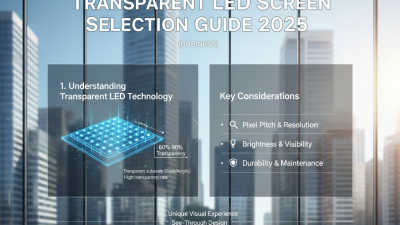
When selecting a transparent LED screen for your business, there are several key features to consider that can significantly impact its effectiveness and return on investment. First and foremost, transparency levels are crucial. Typically, high-quality transparent LED screens offer transparency rates from 60% to 90%, allowing viewers to perceive content without obstructing the view through the screen. This feature is essential for businesses looking to integrate digital signage while maintaining visibility. According to a recent report by MarketsandMarkets, the market for transparent LED displays is expected to reach $5.2 billion by 2025, demonstrating their growing importance in retail and advertising sectors.
Another vital aspect is the brightness and resolution of the screen. A brightness level of 1500 nits or higher is recommended, especially for outdoor applications, where ambient light can hinder visibility. Additionally, a resolution of at least 1080p ensures that visuals remain sharp and engaging. As reported by Display Daily, viewing distance plays a significant role; for better customer engagement, aim for a pixel pitch of less than 10 mm for close-range content.
Tips: Always consider the installation environment. Indoor screens can suffice with lower brightness, while outdoor screens need robust weatherproofing. Furthermore, assess the connectivity options to ensure that the screens can integrate seamlessly with your existing digital infrastructure for effective content management.
2025 Guide: Key Features Comparison for Transparent LED Screens
The Importance of Resolution and Brightness in Transparent LED Displays
In the rapidly evolving world of transparent LED displays, resolution and brightness play pivotal roles in determining the effectiveness of these innovative screens for businesses. As industries increasingly adopt transparent displays for advertising, retail, and automotive applications, understanding these key specifications is essential. According to a recent industry report, displays with a minimum pixel density of 300 PPI are recommended to ensure clarity and detail, particularly in high ambient light environments. Moreover, brightness levels exceeding 1000 nits are crucial for visibility, allowing these screens to stand out in bright settings.
Furthermore, the arrival of Micro LED technology has significantly altered the landscape, offering enhanced brightness and resolution capabilities. Research indicates that Micro LED displays can achieve up to 100,000 nits of brightness, dramatically outpacing traditional LED screens. This advancement not only ensures better performance under varying lighting conditions but also opens up new possibilities for applications like augmented reality and automotive displays. As demonstrated at the recent SID 2025 event, innovations in Micro LED technology are lighting up the future and setting new standards for transparent LED screens in diverse commercial environments.
Assessing Durability and Outdoor Performance for Business Needs
When selecting a transparent LED screen for your business, durability and outdoor performance are crucial factors to assess. Transparent LED screens face various environmental challenges, from fluctuations in temperature to direct exposure to sunlight. Thus, you should prioritize products with robust construction and weather-resistant features. Look for screens that have a high IP rating, which indicates their resistance to dust and moisture. Such specifications ensure that your investment withstands harsh outdoor conditions, providing reliable performance year-round.
**Tips:** Always check the warranty and support options provided by the manufacturer. A solid warranty can be a testament to the product's durability. Additionally, consider the screen's brightness levels; brighter screens are essential for outdoor visibility, especially in direct sunlight.
Furthermore, evaluate the thermal management capabilities of the LED screens. Effective heat dissipation systems are vital for maintaining optimal performance and longevity, particularly in warmer climates. Conduct thorough research, compare various models, and read customer reviews focusing on their outdoor performance experience. This proactive approach will help you choose a transparent LED screen that meets your business needs effectively.
2025 Guide: How to Choose the Best Transparent LED Screen for Your Business
| Feature |
Description |
Importance for Business |
| Durability |
Resilience against weather conditions and physical impacts. |
High - Ensures longevity and reduces maintenance costs. |
| Brightness |
Brightness level necessary for visibility in outdoor environments. |
High - Enhances visibility and engagement during daytime. |
| Transparency |
Level of transparency required to maintain aesthetic appeal. |
Medium - Balances between visibility and aesthetics. |
| Viewing Angle |
Optimal viewing angles for audience engagement. |
High - Ensures messages can be viewed from various angles. |
| Installation |
Ease of installation process for outdoor settings. |
Medium - Affects setup time and costs. |
| Energy Efficiency |
Level of energy consumption during operation. |
High - Reduces operational costs and is environmentally friendly. |
| Cost |
Initial investment and long-term maintenance costs. |
High - Impacts overall budget and ROI. |
Evaluating Cost vs. Value: Budgeting for Your Transparent LED Investment
When considering the investment in a transparent LED screen for your business, it's essential to evaluate the cost versus value effectively. Transparent LED screens can enhance the aesthetics of your space while offering functional advertising opportunities. Therefore, it's not just about the initial purchase price but understanding the long-term returns such an investment can bring. One effective method to assess this is through the Discounted Cash Flow (DCF) analysis, which helps project future cash flows from your investment and discounts them to present value, allowing for a clearer comparison of costs and benefits.
Tips:
- When budgeting for your transparent LED screen, consider the total cost of ownership, which not only includes the purchase price but also installation, maintenance, and energy consumption over time.
- Additionally, it might be beneficial to calculate the Return on Investment (ROI) by analyzing the projected revenue generated from enhanced advertising capabilities, helping you gauge the screen's impact on your bottom line.
Planning for your budget with these methods can maximize the value derived from your investment, ensuring that you make a knowledgeable decision that aligns with your business goals. By focusing on strategic budgeting approaches, like payback periods and ROI calculations, businesses can secure an advantageous position in leveraging transparent LED screens for both marketing and customer engagement.
Trends and Innovations in Transparent LED Technology for 2025
As we move towards 2025, the field of
transparent LED technology is set to experience
remarkable trends and innovations that are transforming how businesses use display solutions.
One significant trend is the increasing integration of
augmented reality (AR) with transparent LED screens.
This fusion allows brands to create immersive experiences by overlaying digital content onto
the real world, enhancing customer engagement. Businesses in retail and advertising are
leveraging this technology to showcase products in a way that captivates consumers,
driving foot traffic and sales.
Another noteworthy innovation is the advancement in
energy efficiency and thinner designs.
Manufacturers are focusing on creating ultra-slim transparent LED panels that not only save
physical space but also reduce energy consumption. This is especially beneficial for businesses
looking to adopt sustainable practices while maintaining high-impact visuals. In addition,
improvements in brightness and color accuracy enable these screens to be effective in various
lighting conditions, expanding their applicability across diverse environments. Overall,
these trends are paving the way for transparent LED technology
to become a cornerstone of modern business marketing strategies in 2025.
















 Screen Size Calculator