What Is the Best Outdoor Display Screen from China?
Choosing the best outdoor display screen from China requires more than comparing brightness and price. A reliable decision should connect field experience, engineering evidence, and supplier accountability. Outdoor LED and LCD systems face direct sunlight, rain, dust, heat, cold, and continuous operation. One weak seal can turn a bright installation into a costly maintenance problem.
Market reports show why this category deserves careful evaluation. Grand View Research has identified digital signage as a growing global market, driven by retail, transport, sports, and public information applications. MarketsandMarkets also forecasts continued expansion in LED display demand, especially for large-format and outdoor installations. However, published estimates differ because researchers define “display,” “LED,” and “signage” differently. That uncertainty matters. Buyers should verify claims instead of repeating impressive percentages.
A practical comparison should examine brightness, pixel pitch, viewing distance, thermal design, power consumption, and service access. For outdoor LED, 5,000 to 10,000 nits may support daytime visibility, but excessive brightness can waste energy and annoy nearby viewers. IP65 protection, based on IEC 60529, is a useful baseline for dust and water resistance, not a complete weather guarantee. Check operating temperatures, corrosion treatment, cabinet drainage, spare-module availability, and warranty response times. A factory video is not enough. Request test records, sample footage under sunlight, and references from comparable climates. The best outdoor display screen from China is rarely the cheapest model; it is the system that remains readable, repairable, compliant, and financially sensible after years outside. Some specifications still need independent verification.
Types of Outdoor Display Screens Available from China
What Is the Best Outdoor Display Screen from China?
Types of Outdoor Display Screens Available from China
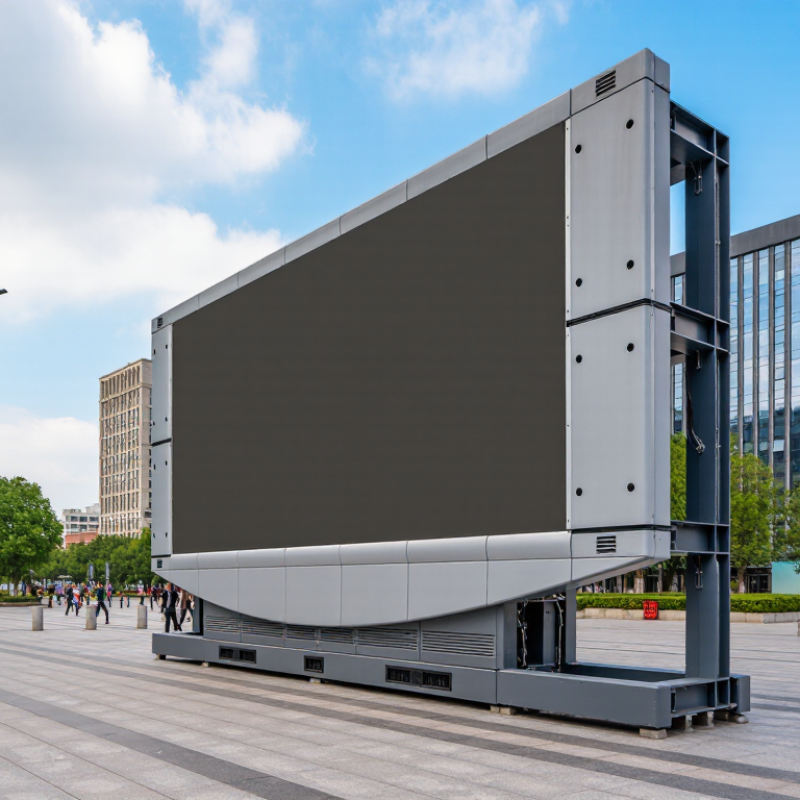
China offers several outdoor display screen types for different locations and budgets. Fixed LED billboards suit highways, stadiums, and building facades. They provide strong brightness and wide viewing angles. Rental LED screens use lighter cabinets and quick-lock structures. Event teams can install them temporarily and move them easily.
Transparent LED screens work well on glass walls and retail windows. Their open design preserves daylight and exterior views. Outdoor LCD signage is another option for menus, transport information, and smaller advertising panels. It usually delivers sharp images, but direct sunlight can reduce visibility. Choosing the right type requires more than comparing prices. Pixel pitch, weather protection, brightness, refresh rate, and heat control all matter.
Tips: Ask for a complete test video before ordering. Check daylight visibility, cabinet sealing, cable quality, and power use. An IP65 rating can help protect the display from rain and dust. Confirm spare modules, warranty terms, and remote maintenance support. A local technician may still be needed.
I have seen buyers focus too heavily on resolution. That can be a costly mistake. Viewing distance often matters more than maximum detail. For example, a roadside screen may need a larger pixel pitch than a close-range storefront display. Ask for sample images in real sunlight. No specification guarantees perfect performance. Installation quality, ventilation, and regular inspection can change the result.
| Display Type | Typical Brightness | Outdoor Protection | Recommended Viewing Distance | Main Advantages | Key Limitations | Typical Applications | Best Choice When |
|---|---|---|---|---|---|---|---|
| Direct-View Outdoor LED | 4,000–8,000 nits | Usually IP65 or higher on the front; rear protection depends on cabinet design | Approximately 5 m to 100 m+, depending on pixel pitch | Very high brightness, excellent daylight visibility, large scalable sizes, wide viewing angles, and easy content updates | Higher power consumption than reflective displays; visible pixel structure at close range; requires proper heat dissipation | Billboards, stadiums, transportation hubs, building façades, plazas, and roadside advertising | Large outdoor image area |
| Outdoor LCD Digital Signage | Typically 2,500–5,000 nits | Commonly designed with sealed enclosures rated around IP55–IP65; exact rating varies by model | Approximately 1 m to 15 m | High resolution, sharp text, strong color consistency, and a familiar flat-panel format | Limited standard sizes, lower scalability than LED, heat management is important, and direct sunlight can reduce image contrast | Bus shelters, self-service kiosks, retail entrances, information points, and menu boards | Close-viewing content |
| Transparent LED Screen | Approximately 3,000–6,000 nits | Outdoor protection varies; weatherproof versions commonly use sealed modules and protected power components | Approximately 5 m to 50 m | Allows daylight and views through glass façades, supports creative architectural installations, and is lighter than many solid display walls | Lower contrast when installed against bright backgrounds; transparent structure can reduce image density; installation requires suitable support | Shopping malls, glass façades, airports, showrooms, and architectural media displays | Glass or façade integration |
| Fine-Pitch Outdoor LED | Approximately 3,000–6,000 nits | Outdoor models may provide IP65 front protection and sealed cabinet construction | Approximately 2 m to 25 m, depending on pixel pitch | Higher pixel density than conventional billboard LED, improved text readability, and better close-range image quality | Higher purchase cost, greater installation precision, and increased sensitivity to thermal and power design | Corporate campuses, outdoor control areas, premium retail sites, museums, and close-viewing public displays | High-resolution outdoor viewing |
| Mobile LED Display Truck | Approximately 4,000–7,000 nits | Display modules are generally protected for outdoor operation; vehicle and electrical systems require separate safety compliance | Approximately 10 m to 100 m | Highly portable, supports temporary campaigns, and can reach multiple locations without constructing a permanent display structure | Limited screen size compared with fixed installations; operation depends on vehicle access, power, traffic rules, and weather conditions | Touring campaigns, public announcements, event promotion, elections, and emergency communication | Temporary or mobile use |
| Outdoor E-Paper Signage | Reflective; does not use a conventional backlight | Weather-resistant enclosures are available, but the required IP rating depends on the installation environment | Approximately 0.5 m to 5 m | Very low energy use, excellent readability in sunlight, and strong suitability for static or slowly changing information | Limited color performance, slower refresh rates, and less suitable for full-motion video or high-impact advertising | Wayfinding, transit information, parking signs, campus notices, and public-service information | Low-power static information |
| Outdoor LED Lightbox or Sign Cabinet | Varies by LED layout and face material; usually lower than direct-view video LED | Weatherproof cabinets commonly use sealed construction; IP rating should be confirmed for the complete assembly | Approximately 2 m to 30 m | Simple design, low content complexity, easy branding changes, and generally lower cost than a full video display | Usually supports static graphics only; limited animation and lower flexibility for real-time content | Storefronts, building signs, roadside panels, real-estate signs, and service-station signage | Static advertising or identification |
Related Posts
-
How to Choose the Best Outdoor Monitor for Your Needs?
-
Best Outdoor LED Screen Options for Your Events and Needs?
-
Best Outdoor Display Screens at the 139th Canton Fair?
-
Why Choose an Outdoor Monitor for Global Sourcing?
-
2026 Top Outdoor Display Technologies and Innovations to Watch?
-
How to Choose the Best Large LED Screen for Your Business?















 Screen Size Calculator