Why Choose an LCD Display Panel for Your Product?
Choosing an LCD display panel can shape how users experience your product every day. It affects readability, power use, durability, and perceived quality.
In product development, LCD technology remains a practical choice for many applications. Engineers can select proven panel sizes, resolutions, viewing angles, and interface options. A seven-inch panel may support a clear dashboard, while a compact three-inch screen can fit inside a handheld meter. Its stable color performance also helps users read figures under office lighting or near a bright window.
Supplier documentation matters. So does hands-on testing. A reliable evaluation should measure brightness, contrast, response time, viewing angle, and operating temperature. It should also check the backlight after long periods of use. Small details matter here. A connector that loosens during vibration can create expensive field problems.
LCD panels are not perfect. They may require more depth than some newer display technologies. Dark scenes can also reveal weaker black levels, especially in low-light environments. These limitations deserve honest consideration. Sometimes, a different display technology may fit better.
Still, LCD panels often offer a balanced combination of availability, cost control, and design flexibility. Product teams can compare samples, review failure data, and test real user conditions before making a decision. That process builds confidence, although it may expose assumptions that seemed reasonable at the beginning.
The right choice depends on the product, not fashion. A carefully tested display panel can make information clearer, operation easier, and the entire device feel more dependable.
What Is an LCD Display Panel and How Does It Work?
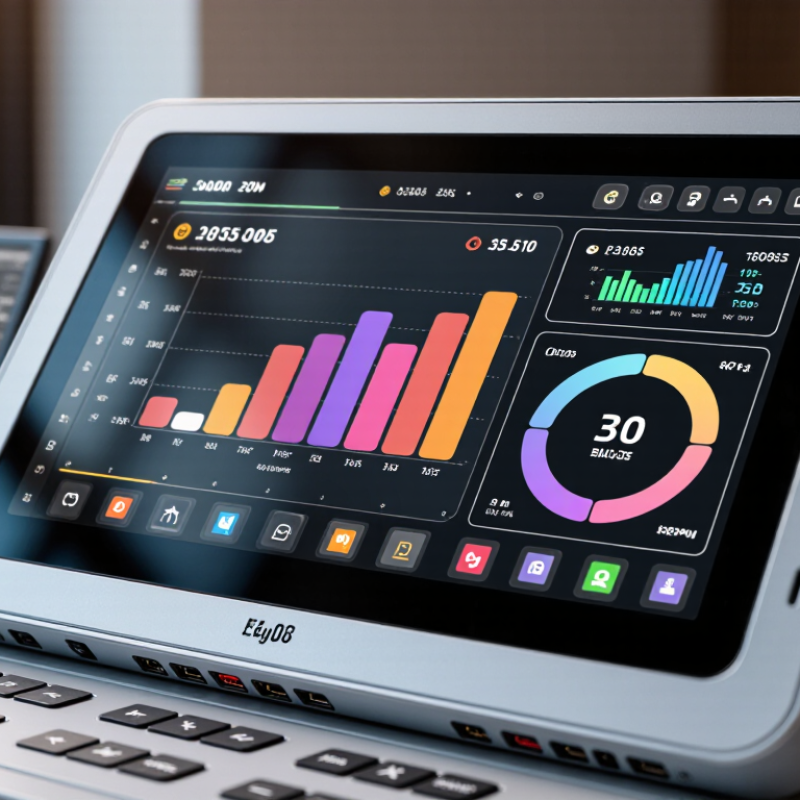
An LCD display panel uses liquid crystals to control light, not create light itself. A backlight sits behind the panel, usually using white LEDs. Polarizing layers direct the light through the cell. Thin-film transistors then apply precise voltage to individual pixels. The voltage changes crystal alignment. This controls how much light passes through red, green, and blue subpixels.
The image forms one pixel at a time. It happens rapidly.
According to Omdia’s 2024 display demand analysis, LCD technology still represents roughly 90% of global display area shipments. Its scale supports mature manufacturing, stable supply, and competitive pricing. A 2024 Display Supply Chain Consultants report also identifies large LCD panels as a major volume segment for monitors, televisions, and commercial equipment. These figures matter when a product needs a 7-inch control screen or a 55-inch public display.
In field testing, viewing angle, sunlight, heat, and touch-glove use often matter more than resolution. A panel may look sharp indoors, yet appear weak beside a factory window. Engineers should check luminance, contrast, response time, interface type, and operating temperature together. That is not always done. Power use also changes with backlight brightness, not only screen size. LCD remains practical, but “low cost” can become misleading after custom tooling, optical bonding, and thermal design are added.
Why Choose an LCD Display Panel for Your Product? - What Is an LCD Display Panel and How Does It Work?
| Data Dimension | Typical Data or Specification | How an LCD Display Panel Works | Product Design Benefit |
|---|---|---|---|
| Display Technology | Liquid crystal display using a liquid crystal layer between two polarizing filters | Liquid crystal molecules change the polarization and transmission of light when an electric field is applied. | Provides a mature, widely available display solution for instruments, appliances, vehicles, and electronic equipment. |
| Backlight Type | Most modern panels use white LED backlighting; some reflective or transflective panels use ambient light. | LEDs provide light behind the liquid crystal cell, while the panel controls how much light passes through each pixel. | LED backlighting supports slim construction, consistent brightness, and long operating life. |
| Pixel Structure | Each color pixel normally contains red, green, and blue subpixels. | Thin-film transistors control individual subpixels, allowing different light levels to create a wide range of colors. | Enables detailed images, readable text, icons, graphs, and user interfaces. |
| Common Panel Modes | Twisted nematic (TN), in-plane switching (IPS), and vertical alignment (VA) | Each mode arranges liquid crystal molecules differently to control light transmission and viewing performance. | Allows designers to prioritize response speed, viewing angle, contrast, or cost according to the application. |
| Resolution Range | From basic character or segment formats to high-definition and ultra-high-definition pixel matrices | Resolution is determined by the number of addressable pixels across the horizontal and vertical axes. | Supports both simple status indicators and information-rich graphical interfaces. |
| Viewing Angle | Approximately 60° to 178° total viewing angle, depending on panel mode and measurement method | Light distribution and liquid crystal alignment affect how image brightness, color, and contrast change off-axis. | Wide-viewing-angle designs improve readability when users are not directly in front of the screen. |
| Response Time | Typically about 1–25 ms for many modern panels; actual performance varies with gray-to-gray measurement conditions. | Response time describes how quickly liquid crystal molecules change state between brightness levels. | Shorter response times reduce motion blur in video, animation, and rapidly changing data. |
| Contrast Ratio | Commonly about 700:1 to 5,000:1 for standard LCD applications, depending on panel type and test conditions | Contrast compares the luminance of the brightest white state with the darkest black state. | Higher contrast improves text clarity, image depth, and visibility in dim environments. |
| Brightness | Common indoor panels are often around 200–500 cd/m²; sunlight-readable designs may use higher values. | Brightness is produced mainly by the backlight and controlled by optical films, panel transmission, and drive settings. | Suitable brightness selection improves readability while helping manage power consumption and heat. |
| Color Depth | Common configurations include 262K colors, 16.7 million colors, and higher levels with additional processing. | Color depth depends on the number of bits used to control each red, green, and blue subpixel. | Provides flexibility for monochrome interfaces, basic color graphics, photographs, and detailed visual content. |
| Typical Operating Temperature | Consumer-grade panels often operate near 0°C to 50°C; industrial versions may support wider ranges such as −20°C to 70°C. | Temperature affects liquid crystal viscosity, response time, contrast, and backlight performance. | Choosing the correct temperature rating improves reliability in indoor, outdoor, industrial, and automotive environments. |
| Power Consumption | Common small panels may consume below 1 W, while larger or brighter panels can require several watts or more. | Power is used by the backlight, timing circuitry, source and gate drivers, and interface electronics. | Designers can balance screen size, brightness, refresh rate, and battery life to meet system power targets. |
| Interface Options | Common interfaces include parallel RGB, LVDS, MIPI DSI, SPI, and I²C for selected display modules. | The interface transfers pixel data and control signals from the host processor to the display driver electronics. | Multiple interface options simplify integration with microcontrollers, processors, and embedded computing platforms. |
| Touch Integration | Touch functionality may be added using resistive, projected capacitive, or other touch-sensing technologies. | A touch layer detects pressure or changes in electrical capacitance and sends the touch coordinates to the host system. | Combines visual feedback and user input in control panels, handheld devices, kiosks, and equipment interfaces. |
| Form Factor | Available in rectangular, square, round, bar-type, and custom-cut configurations, subject to manufacturing limits. | The active display area, bezel, glass substrate, driver placement, and mounting structure determine the final module shape. | Supports compact product layouts and application-specific mechanical designs. |
| Optical Surface | Glossy, anti-glare, anti-reflective, and hard-coated surface treatments are commonly available. | Surface treatments control reflections, scattering, and resistance to scratches or surface wear. | Improves usability under office lighting, outdoor light, protective windows, or frequent-touch conditions. |
| Refresh Rate | Many general-purpose panels operate at 60 Hz; higher-refresh designs are available for motion-focused applications. | The display refreshes pixel data at a defined frequency to update moving images and changing information. | Higher refresh rates can improve motion smoothness, while 60 Hz is sufficient for many static or lightly animated interfaces. |
| Main Advantages | Thin profile, low power compared with many older display technologies, stable image quality, and scalable sizes | The panel modulates light rather than generating light directly at each pixel, with the backlight providing illumination. | Offers a practical balance of cost, performance, availability, integration flexibility, and product durability. |
Related Posts
-
2026 Best Display Panel Types for Global Buyers?
-
Top 10 LED Display Innovations Transforming Digital Marketing Today
-
2026 Best LED Display Options for Modern Event Experiences?
-

Top 10 LCD Screen Suppliers for Your Global Sourcing Needs?
-
How to Choose the Right Transparent LED Screen for Your Business Needs
-
What Is the Best Outdoor Display Screen from China?


 Screen Size Calculator