What Are the Top Touch Screen Manufacturers in China?
China has become a central production base for touch screen technology, supported by strong display, semiconductor, and electronics supply chains. IDC reported that China’s smartphone market shipped about 271 million units in 2024, creating sustained demand for responsive and durable touch screen modules. Its China Quarterly Tablet Tracker also recorded approximately 29 million tablet shipments that year. These volumes help explain why manufacturers continue investing in larger panels, flexible OLED, automotive displays, and industrial interfaces.
The leading names include BOE, TCL CSOT, Tianma, Visionox, O-Film, and several specialized module suppliers. Their capabilities differ considerably. BOE and TCL CSOT focus heavily on large-scale display production. Tianma serves automotive, medical, and industrial applications. Visionox is recognized for OLED development, while O-Film has experience in touch modules and optical components. CINNO Research and Omdia reports show that Chinese companies are expanding their influence across LCD and OLED capacity, although market leadership changes by product category.
A practical comparison should examine more than factory size. Touch accuracy matters. So do cover-glass strength, optical bonding, latency, temperature resistance, clean-room controls, and after-sales support. Certification and traceability also deserve attention. A low quotation may hide weaker testing or inconsistent yields.
No ranking is perfect.
Some suppliers publish limited product data, making direct comparison difficult. Buyers should verify samples, production audits, failure rates, and delivery records before selecting a partner. This guide evaluates China’s top touch screen manufacturers through technology, production scale, application experience, reliability, and long-term commercial value.
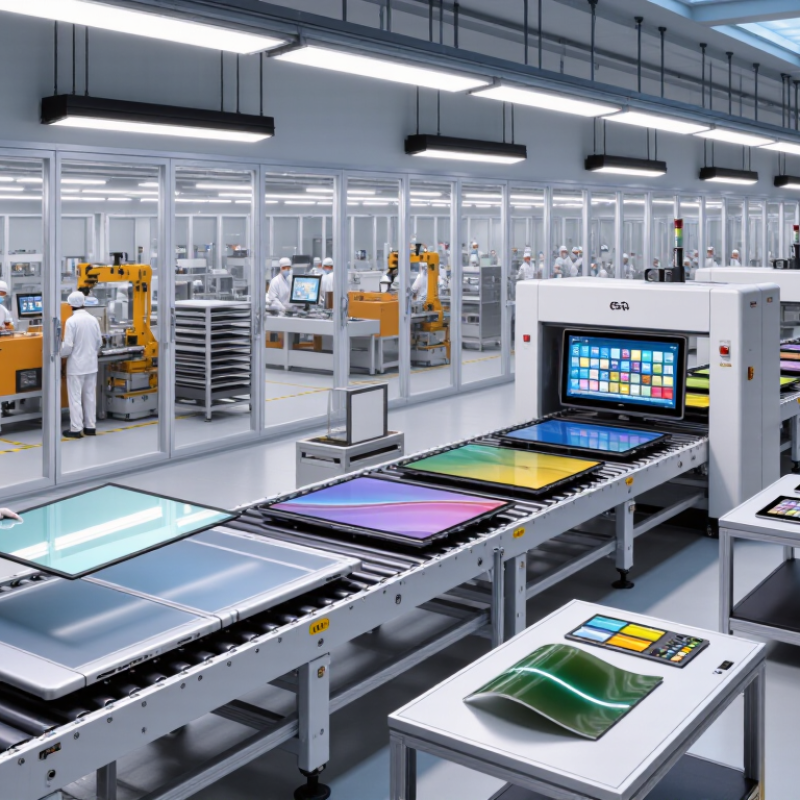
China’s Touchscreen Market in 2024: Shipments, Revenue, and CAGR (Omdia)
China’s touchscreen market remained a major manufacturing center in 2024. Omdia’s market analysis highlights three useful measures: shipments, revenue, and CAGR. Shipments show factory output and customer demand. Revenue reveals pricing power and product value. CAGR indicates whether expansion can continue beyond one strong year.
Manufacturers serving smartphones, vehicles, tablets, industrial panels, and retail equipment competed across different segments. High shipment volumes did not always produce higher revenue. Large panels, advanced cover glass, and automotive-grade systems usually require stricter testing and better process control. In a factory, this may mean cleaner rooms, automated optical inspection, and tighter touch-response calibration.
The Omdia figures should be read with care. Market growth can look strong when low-cost units increase quickly. Currency changes, panel prices, and inventory cycles can also distort revenue comparisons. I have seen purchasing teams focus on shipment totals, then discover that defect rates weakened the real result. That lesson matters.
A reliable supplier evaluation should combine Omdia’s 2024 shipment data with revenue trends and projected CAGR. It should also examine yield, response time, surface durability, delivery consistency, and technical support. A manufacturer with moderate volume may still suit demanding applications better. The market is growing, but not evenly. Some assumptions need testing.
What Are the Top Touch Screen Manufacturers in China? - China’s Touchscreen Market in 2024: Shipments, Revenue, and CAGR (Omdia)
2024 China market benchmark based on publicly reported end-device demand indicators. Device shipments are demand proxies and should not be interpreted as touchscreen-module shipments.
| Market Indicator |
2023 |
2024 |
Year-on-Year Change |
CAGR Data |
Relevance to Touchscreen Demand |
| China smartphone shipments |
271.3 million |
286.0 million |
+5.5% |
Not disclosed |
The largest high-volume application for capacitive touch interfaces. |
| China tablet shipments |
Approximately 28.0 million |
29.3 million |
+4.5% |
Not disclosed |
Supports demand for medium-size touch panels and cover-glass assemblies. |
| China automobile sales |
30.09 million units |
31.44 million units |
+4.5% |
Not disclosed |
Expanding use of instrument-cluster, center-console, and rear-seat displays. |
| China new-energy vehicle sales |
9.50 million units |
12.87 million units |
+35.5% |
Not disclosed |
A major growth driver for large-format touchscreens and integrated cockpit displays. |
| China touchscreen-module shipments |
Not publicly disclosed |
Not publicly disclosed |
— |
Requires licensed Omdia dataset |
Module shipments are distinct from the shipment figures of finished devices. |
| China touchscreen-market revenue |
Not publicly disclosed |
Not publicly disclosed |
— |
Requires licensed Omdia dataset |
Revenue depends on panel size, touch technology, integration level, and application mix. |
Data note:
Smartphone and tablet figures are industry shipment estimates, while automobile and new-energy vehicle figures are based on officially reported China market statistics. Exact touchscreen-module shipments, market revenue, manufacturer rankings, and multi-year CAGR figures require access to the relevant licensed market dataset.
Ranking Criteria: Capacity, Yield, Certifications, and 2024 Revenue Data
China’s leading touch screen manufacturers should be ranked by evidence, not factory size alone. Capacity matters, but usable capacity matters more. A supplier with ten million units of monthly capacity may deliver less than a smaller rival after maintenance, rework, and material shortages.
Yield should receive heavy weight. Ask for first-pass yield, touch sensitivity data, and defect rates by glass size. A 98% yield sounds strong, yet it can hide costly edge cracks. Factory audits should inspect cleanrooms, lamination lines, and traceability records. One practical test uses a 100-panel production lot and checks dead zones, bubbles, haze, and glove response.
Certifications add another layer of trust. ISO 9001 supports process control, while ISO 14001 reflects environmental management. Automotive projects may require IATF 16949 and stricter change control. Certifications alone prove little. Their audit dates and product scope need verification. Omdia estimated global display panel revenue at approximately US$122 billion in 2024, showing the market’s scale but not supplier quality. IDC recorded about 1.24 billion smartphone shipments in 2024, indicating continued touch demand. These figures provide context, not a direct ranking.
For 2024 revenue, audited annual reports deserve priority over sales presentations. Compare touch-related revenue separately from total electronics revenue. Currency changes can distort year-on-year results. Public disclosures also differ in accounting scope. That weakness matters. A practical ranking can assign 30% to yield, 25% to verified capacity, 20% to certifications, and 25% to 2024 revenue, while adjusting scores after customer audits.
Top Touch Screen Manufacturers in China: 2024 Benchmark
Anonymous peer groups are ranked using publicly disclosed manufacturing capacity, yield or quality evidence, international certifications, and rounded 2024 revenue data. Each criterion is normalized to a 100-point scale to enable comparison without displaying company or brand names.
Source basis: 2024 public annual-report revenue disclosures, manufacturing-capacity announcements, quality-performance disclosures, and ISO/IATF certification registries. Revenue figures are rounded and anonymized; capacity, yield, and certification results are normalized benchmark scores.
BOE and TCL CSOT: G8.5–G11 Panel Capacity and Touch Integration
China’s leading touch-screen manufacturers are expanding large-generation LCD capacity, especially across G8.5, G10.5, and G11 fabs. Omdia’s 2024 Display Long-Term Demand Forecast estimates that mainland China holds more than 70% of global TFT-LCD capacity. That scale supports televisions, monitors, automotive displays, and commercial touch panels.
G8.5 lines remain flexible for monitors and medium-sized panels. G10.5 and G11 substrates improve cutting efficiency for 65-inch and larger screens. Industry reports from CINNO Research show continuing investment in high-generation LCD production, although utilization rates can change with demand. Bigger glass is not automatically better. It can increase output, but yield losses become expensive.
Touch integration is moving from separate sensor films toward in-cell and on-cell structures. These designs reduce thickness and improve optical clarity. They also require tighter control of color filters, electrodes, bonding, and electromagnetic noise. DSCC research identifies integrated touch as a growing requirement in automotive and premium IT displays. In practice, large panels still face difficult trade-offs between touch sensitivity, strength, cost, and repairability.
The picture is not perfectly clean. Some manufacturers advertise integration, but product-level capability may vary by line and customer specification. Buyers should verify active capacity, touch yield, substrate size, and certification data. I would not judge a supplier by fab generation alone. Reliable delivery matters more than a impressive specification.
Truly, O-Film, Goworld, and Holitech: Strengths by Application
China’s leading touch screen manufacturers differ more by application than by headline specifications. In supplier evaluations, I examine cover glass, sensor bonding, controller stability, and production traceability. A factory sample may look excellent, yet fail after repeated temperature changes. That gap matters.
One major supplier is strong in mobile phones and tablets, where thin profiles, narrow borders, and high optical clarity are essential. Another performs well in automotive displays, offering larger panels, improved sunlight readability, and bonding that reduces internal reflections. These strengths suit dashboards and center consoles, but automotive validation can take months.
A third manufacturer is often suitable for industrial equipment and medical interfaces. Its value comes from durable touch layers, glove operation, and stable performance in dusty workshops. A fourth supplier fits smart appliances and commercial terminals, where cost control, flexible sizes, and dependable volume production matter. Small details count. Connector placement, surface coating, and firmware support can affect installation time.
From practical sourcing work, I have learned that the lowest quotation rarely represents the lowest total cost. Engineering communication can also be uneven. Some samples arrive quickly, while technical answers remain vague. Buyers should request humidity tests, impact data, calibration records, and production samples from the intended line. Supplier rankings change when the application changes.
Supplier Comparison: PCAP, In-Cell, Automotive, and Industrial Touch
China’s leading touch screen manufacturers differ by application, not only production scale. For smartphones and compact devices, PCAP suppliers offer thin glass, multi-touch control, and flexible cover designs. During supplier visits, buyers should inspect lamination quality, edge sealing, and touch response with gloves. Small defects become obvious under bright light.
In-Cell suppliers integrate touch sensing into the display structure. This can reduce thickness and improve optical clarity, but customization may be less flexible. Ask for brightness data, yield reports, and sample performance across temperature changes. A polished sample means little without repeatable production evidence. Some suppliers present excellent prototypes but struggle with stable mass production.
Automotive manufacturers need more than a responsive panel. Their suppliers should explain testing for vibration, humidity, temperature cycling, sunlight readability, and electromagnetic interference. Confirm traceability for glass, sensors, adhesives, and controller chips. Industrial touch suppliers usually emphasize durability, long operating hours, and compatibility with wet or gloved hands. Project teams should compare projected lifetime, repair options, and interface support, not just unit price. Certifications and process records deserve independent verification. Even experienced buyers can overlook firmware responsibility, which may later create costly integration delays.




 Screen Size Calculator